The First Week: Why Authority Is Claimed, Not Conferred.
Andy Burnham has done more to establish authority in a week than his predecessor managed in two years. The lesson isn't about politics. It's about how power is actually taken.
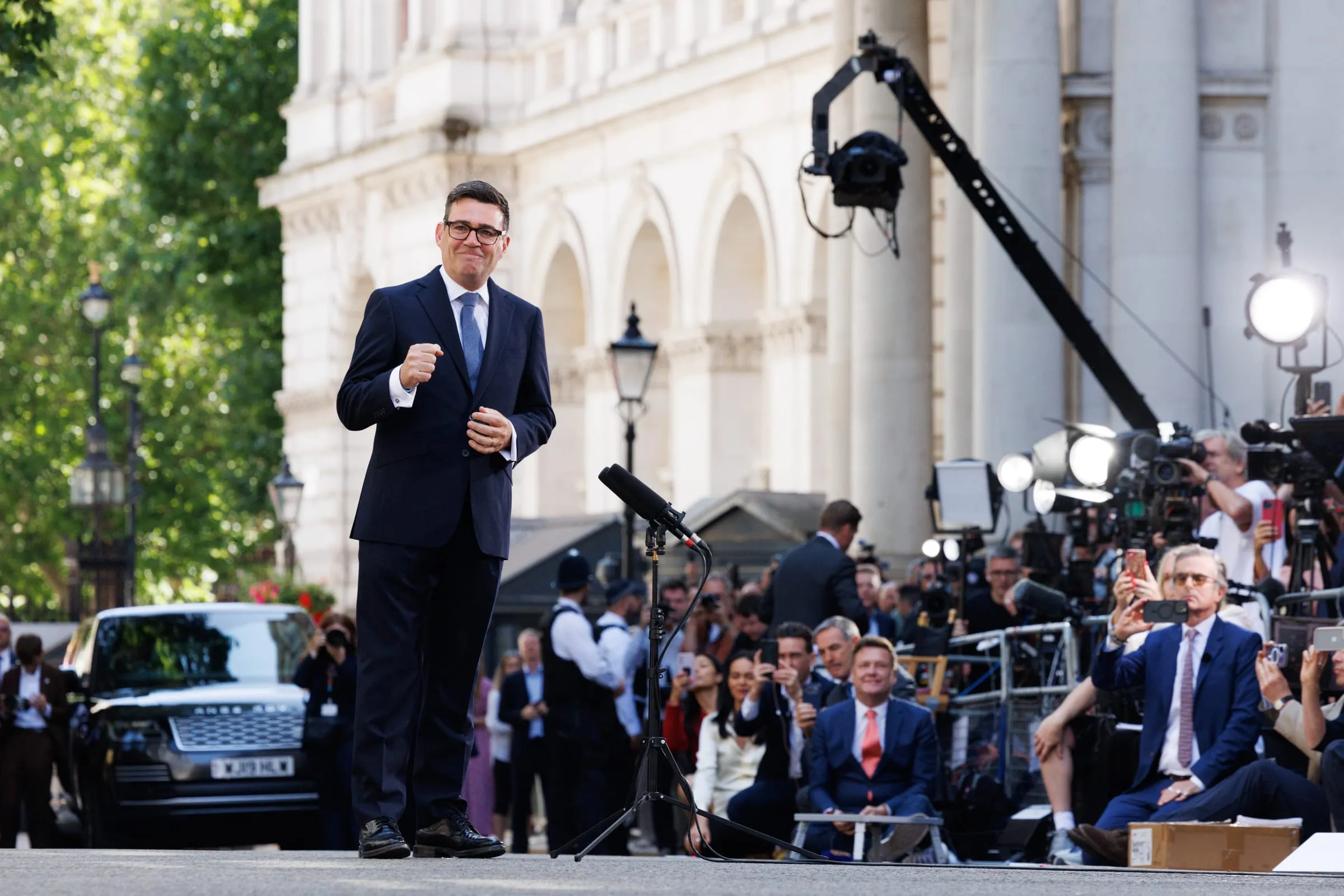
There was no lectern.
For a decade, the four feet of varnished wood wheeled out onto Downing Street has been the visual grammar of British political crisis: a new one commissioned for each new tenant, each arrival, each resignation. On Monday 20 July, Andy Burnham walked up Downing Street, stood in front of the black door, and spoke without one. No podium. No notes. No autocue. The bespoke Downing Street lectern is a modern invention, dating to David Cameron in 2010. Every prime minister since has used one to address the country for the first time. Burnham did not.
It is a small thing. It is also the entire story.
The lectern is a prop that does a specific job. It puts an object between the leader and the audience, and it holds the paper that proves the words were approved by someone else. Removing it is a statement that the person speaking is the person deciding. Burnham’s line, that politicians “have not been good enough and we need to be better,” would have sounded like penance from behind the wood. Delivered unaccompanied, it sounded like a diagnosis, and a diagnosis is the property of the person qualified to make it.
Compare this to July 2024. Keir Starmer arrived at the same door with a professionally prepared text and a governing philosophy that would define his premiership: build the brief, secure the position, take no step you cannot defend. He left it two years later saying he accepted his party’s verdict “with good grace.” Between those two sentences sits the central question of modern leadership: what actually confers authority on a person who already holds the office?
The answer is not the office. Starmer had a majority of 174 and could not command his own backbenches. Burnham arrived with no general election mandate, having been an MP for four weeks. Yet within seven days one of them had visibly seized the machine and the other had visibly been consumed by it.
Power in an institution is not transferred at the moment of appointment. It is claimed, or forfeited, in the period immediately afterwards, when everyone is watching to learn what kind of leader has arrived.
I have seen enough CEO and chair transitions to know that the fortnight after the announcement is not an administrative period. It is the whole negotiation. By the time the new leader has settled in, the organisation has already decided what it is permitted to get away with.
Authenticity is an operating system, not a soft skill
The consultancy industry has spent fifteen years selling “authentic leadership” as a personality accessory: be more vulnerable, tell a story about your father, use fewer slides. This is why serious executives roll their eyes at it. It is treated as a communications garnish rather than an operating decision.
Burnham’s first week is a useful corrective, because the authenticity is not decorative. It is structural.
Starmer led as a Director of Public Prosecutions leads: assemble the evidence, test it to destruction, act only when the case is unassailable. That is an admirable instinct in a courtroom and a defensible one in a regulated business. It is a catastrophic instinct in a role where the market for your authority is the public’s belief that you are in charge. Rigour reads as caution. Caution reads as fear. And a leader who is visibly afraid of being wrong teaches the entire organisation to be afraid of being wrong.
Burnham’s register is different in kind, not just in tone. He was formed outside Westminster, with nine years running a city region as Mayor of Greater Manchester: a real budget, real delivery failures, and a genuine constituency who could see him. This is the opposite of the insulated reality that produces most institutional leaders, and it shows. It produces a specific quality scripts cannot manufacture, which is the ability to answer a question he has not been prepared for without the visible cost of processing it. That is the actual test. Not whether a leader is “relatable.” Whether they can be interrupted, contradicted or blindsided and remain recognisably the same person.
Consider the pub. On Thursday, Burnham and his new Chancellor, John Healey, announced a 20% cut in business rates for pubs, clubs and live music venues, affecting roughly 32,000 venues at around £1,100 a year each. They then went to The Hare in Harlow, a three bar inn trading since 1897, and Burnham pulled Healey a pint. His line was that “pubs need to know that the cavalry is coming.” A day later the two of them were filmed blind ranking pub snacks, the Chancellor of the Exchequer declaring for scratchings, the Prime Minister for crisps.
It would be easy to file this under content. But it isn’t. Note the sequence. The policy came first, and it was a real policy with a named funding mechanism and a start date. The video was the delivery vehicle, not the substance. That distinction is the whole game. An executive who does the human, unpolished thing without the decision underneath it is performing. An executive who makes the decision and then explains it in the language of the people it affects is governing.
The choice of terrain is not accidental either. “Cost of living” has become an abstraction: an index, a chart, a line in a briefing. A pub is not an abstraction. It is where the country conducts its actual social life, and on Friday evening it gave people in every town in Britain something to talk about that had a governmental cause. That is not communications. That is a leader locating his authority in a place his predecessor could not reach.
Polished, in the sense that matters, does not mean prim. It means the message survives contact with a real environment.
The decisiveness paradox
Now the substance, because presence without decisions is just charisma with a diary.
Seven days produced: a first instruction to end rough sleeping, backed by an additional £340m; a cabinet assembled by Monday night with close to a dozen ministers dismissed, including the Chancellor; VAT on electricity bills cut to zero for six months from October; the £2 bus fare cap restored; the business rates cut for hospitality; a pause on the early prisoner release scheme; and the launch of No 10 North in Manchester, with a National Economic Council convened on the same day.
Gladstone’s line was that the first requirement of a prime minister is to be a good butcher. Burnham was. Rachel Reeves was sacked and declined an alternative post. Healey, who had resigned from Starmer’s government weeks earlier over defence funding, was moved into the Treasury. Burnham declined to appoint a deputy at all, instead making Louise Haigh First Secretary of State: the same power, a different wiring diagram. Read that as what it is. He did not inherit an organisational chart. He drew one.
None of it was uncontested. The gilt market wobbled on the removal of Reeves and on early signals about flexibility within the fiscal rules, before settling once the full cabinet was visible. Kemi Badenoch’s attack was the obvious one and not an unreasonable one: who pays? Restaurants and cafés, excluded from the rates cut, said so publicly. Angela Rayner’s defence of the week was that it amounted to “a down payment within the first week,” an admission that it does not fix the underlying problem.
Here is the part that senior executives consistently get wrong.
Disagreement is not the enemy of authority. Absence is. A leader who decides can be argued with, lobbied, corrected, even defeated, and every one of those interactions confirms there is a centre of gravity in the building. A leader who defers creates a vacuum, and vacuums do not stay empty. They are filled by the chief of staff, by the loudest faction, by the general counsel, by the press office, by whoever is willing to act while the principal consults.
Institutions do not lose faith in leaders because of controversial decisions. They lose faith because of unmade ones. After years of the machine visibly not moving, the population of any organisation will grant enormous latitude to the first person who moves it, not because they agree with the direction, but because motion itself is evidence that someone is at the controls.
Momentum is not a mood. It is a governing asset, and it depreciates from the moment you take office.
What the first week cannot tell you
I would be doing my own argument a disservice if I stopped there, because a first week is a genre rather than a record. Every incoming leader gets one. The relevant question is which parts of it are load-bearing.
The scrutiny has not started. Parliament rose for recess and Burnham will not face the Commons until September. His entire premiership to date has been conducted in front of cameras he chose, in rooms he selected. Unscripted in a pub is not the same as unscripted at the despatch box, and no assessment of a leader’s judgement under pressure is complete until you have watched them handle a hostile institution rather than a friendly crowd.
None of these decisions has cost anyone anything yet. This is the sharper version of the critique, and it is the one a sceptical chair would put to me. Every measure of the first week is a giveaway: money off a bill, money off a fare, money off a rates demand. Sacking close to a dozen ministers is decisive, but it is decisiveness exercised against people who could not resist it. The genuine test of a decisive leader is not the speed of the first decision. It is the first decision that visibly takes something away from a constituency the leader needs. Burnham has not made one. Until he does, we are measuring tempo, not judgement, and the two are routinely confused by people who should know better.
The pledges are maximalist and the record is mixed. Burnham promised to end rough sleeping in Greater Manchester by 2020 and did not. The numbers rose across his mayoralty. Starmer’s failure was setting targets so narrow that nobody was moved by them. The opposite failure is available and it is more expensive, because bold objectives create the possibility of visible, dateable failure. Latitude granted early is repossessed with interest.
The economics are not yet an economic model. Roughly £45 off a household’s energy bill across six months, less once the price cap rise lands in October, and £1,100 off a pub’s rates are real. They are also small, popular and cheap relative to the problem. The gilt market does not price sentiment. The autumn budget is where this premiership is actually underwritten, and no amount of first-week authority survives a fiscal event that fails to add up.
Style buys time. It does not buy outcomes. It buys the space in which outcomes must then be produced, which is precisely why squandering the first week, as most leaders do, is such an expensive habit.
The authenticity premium, and its ceiling
On 23 July, Elon Musk sat down with Zanny Minton Beddoes, editor-in-chief of The Economist, for an interview that turned combative. Pressed on the proposition that people loathe him, Musk’s answer was that “a lot more people like me than don’t,” and that the same public holds the media in considerably lower esteem than the media believes.
You can dispute the arithmetic. You can dispute a great deal else in that interview. But the underlying claim is worth taking seriously, because it is the same claim that carried Donald Trump past every conventional prediction. A substantial part of the public will extend trust to a person who is unmistakably themselves, even while disagreeing with much of what that person says. What is being rewarded is not the content of the position. It is the absence of a gap between the public performance and the private operator.
That premium is now visible across business and politics, and it is routinely misread as permission to be unfiltered. It is not. The market is not rewarding rudeness, or spontaneity, or the deliberate rejection of preparation. It is rewarding coherence under live conditions: the leader who can be asked something they did not expect and answer as the same person who was speaking a minute earlier.
Scripts were never a communications strategy. They were a risk management strategy, designed for an environment where the leader’s exposure could be controlled. That environment no longer exists. Every meeting is recorded, every remark is clipped, every inconsistency is retrievable in seconds. In that world, rigidity is not safety. It is the thing that gets you found out, because the gap between the prepared self and the real one is now trivially easy to see.
Musk is also, usefully, the demonstration of where the premium runs out. Being unmistakably yourself buys attention and it buys a constituency. It does not buy immunity from the consequences of the decisions you make while everyone is watching. Authenticity determines whether people listen. Judgement determines whether they are still listening in three years. Confusing the two is the most expensive error available to a leader who has just discovered they are good at the first one.
Which returns us to the missing lectern.
Burnham’s first week is not evidence that he will be a good prime minister. It is evidence that he understands something a great many chief executives, chairs and boards still do not: authority is not conferred by the appointment. It is claimed in the days immediately after it, and it is claimed by people who are visibly making decisions as themselves.
The rest of it, the delivery, the budget, the September despatch box, is judgement. And judgement is a longer test than presence.
But you cannot exercise judgement from a vacuum. First you have to take the room.
Dale McDermott
On judgement, power and institutions.